There is a silence that sits inside some of us,
a silence that isn’t really silence at all,
it is the echo of doors that closed too soon,
the sound of footsteps fading down hallways
that never came back.
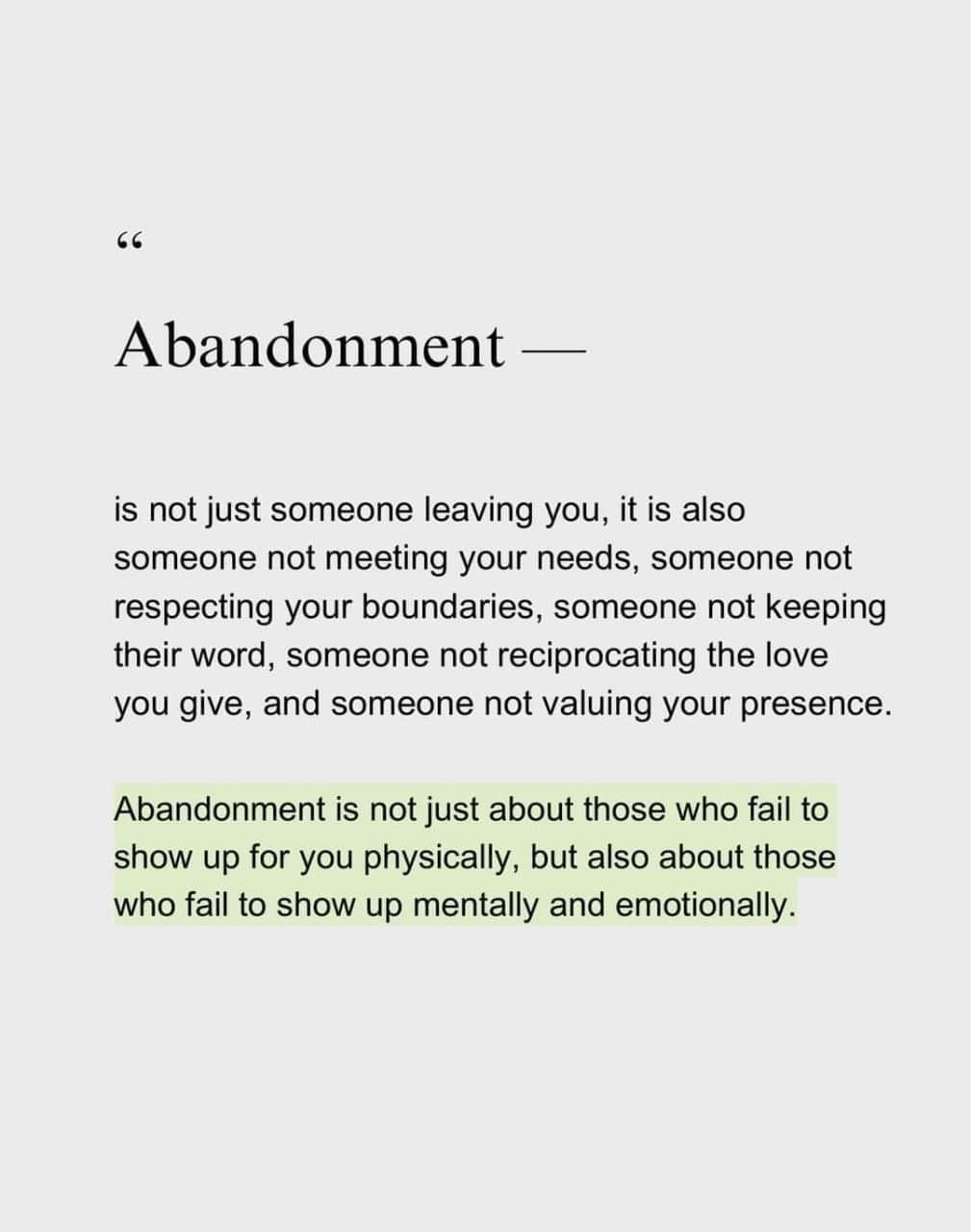
Abandonment is not only being left,
it is being taught,
by action or absence,
that love is conditional,
that presence is fragile,
that home can collapse overnight.
It is the child waiting at the window
for the father who never arrives.
It is the daughter pretending she doesn’t mind
when her mother’s voice cuts sharp,
when her mother’s arms are too tired to hold.
It is birthdays missed, promises broken,
the repeated lesson: you are not enough to stay for.
And so we carry it.
We grow older,
but the wound grows with us.
It dresses itself in adult clothes,
wears perfume, files taxes, builds businesses,
but beneath the surface, it still whispers:
“don’t trust too much,
don’t lean too heavy,
don’t expect anyone to stay.”
It shapes how we love.
It shapes how we leave.
It teaches us to self-abandon
before anyone else can do it first.
Abandonment wounds are mirrors.
They reflect us back to ourselves in distorted glass.
They tell us stories that are not true,
but because they were repeated so often,
we take them as scripture.
The mirror says:
“If they left, it must be you.”
The mirror says:
“Hold tighter, give more, earn love, beg for crumbs.”
The mirror says:
“Be the strong one, the savior, the one who never asks,
because asking is dangerous. Asking gets you left.”
And so we date people who cannot hold us.
We chase love that is distant,
because distance feels familiar.
We confuse chaos with passion,
and silence with rejection.
We build entire lives around avoiding
the possibility of being left again.
And yet,
the mirror is not the truth.
It is only glass, only shadow.
The wound is not who you are.
It is what happened to you.
To heal, you must name it.
To say out loud:
“I was abandoned. I was left. I was hurt.”
To strip away the shame,
to tell the story in daylight.
Abandonment is not your fault.
It is not proof of unworthiness.
It is a wound inflicted,
not an identity inherited.
Say it:
“I was abandoned, but I am not abandonment itself.
I was left, but I am not unlovable.
I was forgotten, but I am not forgettable.”
Naming separates the wound from the woman.
Naming is the first cut of freedom.
Let us not sugarcoat it,
abandonment hurts in ways
that no affirmation can instantly erase.
It hurts in the body:
tight chest, shallow breath,
hypervigilance that scans every room for rejection.
It hurts in relationships:
choosing partners who replay the same wound,
chasing those who will not stay,
turning away from those who would.
It hurts in the soul:
the belief that God, too, might leave,
that blessings are temporary,
that joy is a trap.
And it hurts most in the quiet moments:
when you achieve something great
but have no one you trust to share it with.
When you lay in bed beside someone
and still feel alone.
When you are surrounded by people,
but your inner child still whispers:
“will they leave too?”
Abandonment teaches you
to rehearse loss before it arrives.
And that rehearsal robs you of presence,
of joy, of intimacy.
For many women like us,
abandonment did not start with us.
It runs down bloodlines.
It is in the father who was not present,
the mother who stayed but was too tired,
the grandmother who raised children alone,
the great-grandmother who loved men at war,
the great-great who never had a choice.
We carry generations of absence in our bones.
We inherit silences,
half-love,
half-truths,
grief not spoken aloud.
But we are also the generation that can say:
It stops here.
The cycle ends with me.
I will not hand this wound down to my daughter,
my son,
my lineage.
I will learn to stay,
especially with myself.
How do we heal an abandonment wound?
Not by pretending it doesn’t exist.
Not by rushing to forgiveness before the grief has been felt.
Not by clinging to toxic bonds in the name of loyalty.
Healing begins with presence.
With staying when you want to run.
With breathing through the panic of intimacy.
With letting yourself be held, even if your body trembles.
Healing looks like therapy,
like journaling through tears at 2 a.m.,
like rage that finally finds a safe place to roar.
It looks like writing letters you’ll never send,
screaming into pillows,
walking out of rooms where love feels like punishment.
It looks like boundaries,
learning that “no” is not a death sentence,
that people who are meant to stay
will stay even when you say “enough.”
It looks like self-parenting,
holding your inner child on your own lap,
whispering:
“I will never leave you again.
Not for love, not for work, not for fear.
I am here. I am yours.”
Healing is not linear.
Some days you will feel free,
others you will feel the ache return.
But each time you choose presence over panic,
each time you soothe instead of self-abandon,
you rewrite the story in your nervous system.
This is alchemy:
turning the lead of loss into the gold of self-love.
There is a woman you are becoming,
a woman who does not beg,
who does not chase,
who does not shrink to be chosen.
She knows her worth is not tied to who stays.
She knows her body is a home,
not a hotel with revolving doors.
She knows love that requires self-erasure
is not love, but hunger.
This woman,
the one you are becoming,
stays.
She stays with herself.
She stays through the hard days,
through the loneliness,
through the grief.
She does not run from her own heart.
And because she stays with herself,
she attracts those who stay too.
People who can meet her where she is,
who love with open palms,
who build, not abandon.
To release the wound,
you must grieve it.
Grieve the father who was not there.
Grieve the mother who couldn’t give more.
Grieve the lovers who ghosted,
the friends who betrayed,
the people who promised and disappeared.
Grieve it fully,
then open your hands.
Release them.
Not to excuse,
not to erase,
but to free yourself
from carrying their absence as your identity.
Release is not forgetting.
Release is saying:
“I choose not to chain myself to what I did not receive.
I choose to live open,
not closed.
I choose to trust again,
not because they earned it,
but because I deserve it.”
Release is a soft exhale:
no more rehearsing abandonment,
no more bracing for departure,
no more preemptive self-sabotage.
Release is choosing presence.
Sister,
you are not too much.
You are not too needy.
You are not unworthy of staying.
The wound lied to you.
The absence lied to you.
The leaving lied to you.
You are not a burden.
You are a garden.
And anyone who cannot water a garden
has no business standing in its shade.
You deserve arms that don’t flinch,
love that doesn’t scatter,
presence that doesn’t punish.
And until that arrives,
you deserve your own staying.
Stay with yourself.
Stay with your body.
Stay with your dreams.
Stay when it feels easier to run.
Stay long enough to see the healing bloom.
Healing abandonment wounds
is not about making sure no one ever leaves again.
That’s impossible. People come and go.
Life ebbs and flows.
Healing is about knowing,
deep in your marrow,
that when others leave,
you will not leave yourself.
It is about walking into relationships
from fullness, not famine.
It is about setting boundaries that protect your soul,
not apologizing for existing.
It is about becoming so anchored in your worth
that departures no longer feel like death.
And one day,
you will notice the shift.
You will notice that when someone doesn’t call back,
your world does not collapse.
You will notice that when conflict arises,
you no longer abandon yourself to keep the peace.
You will notice that you can love deeply
without bargaining your soul for scraps.
This is what freedom feels like.
Not the absence of loss,
but the presence of self.
To the women like me,
carrying wounds older than our own memories:
may you grieve what was taken,
may you bless what remains,
may you release what chains.
May you learn to stay.
May you learn to trust.
May you learn to love without vanishing.
And may you one day look in the mirror
and see not the wound,
but the woman,
whole, radiant, unshaken,
the woman who chose to stay.