I think about plumeria a lot, though I never knew I would. There’s something about them that lingers in the way memory lingers, soft, unassuming, and impossible to forget.
The first time I smelled one, it was like inhaling a fragment of a warm, slow morning that didn’t yet exist. The scent stayed in me, not cloying, not demanding attention, but somehow claiming a space in my chest, like it had always been there, waiting for me to notice.
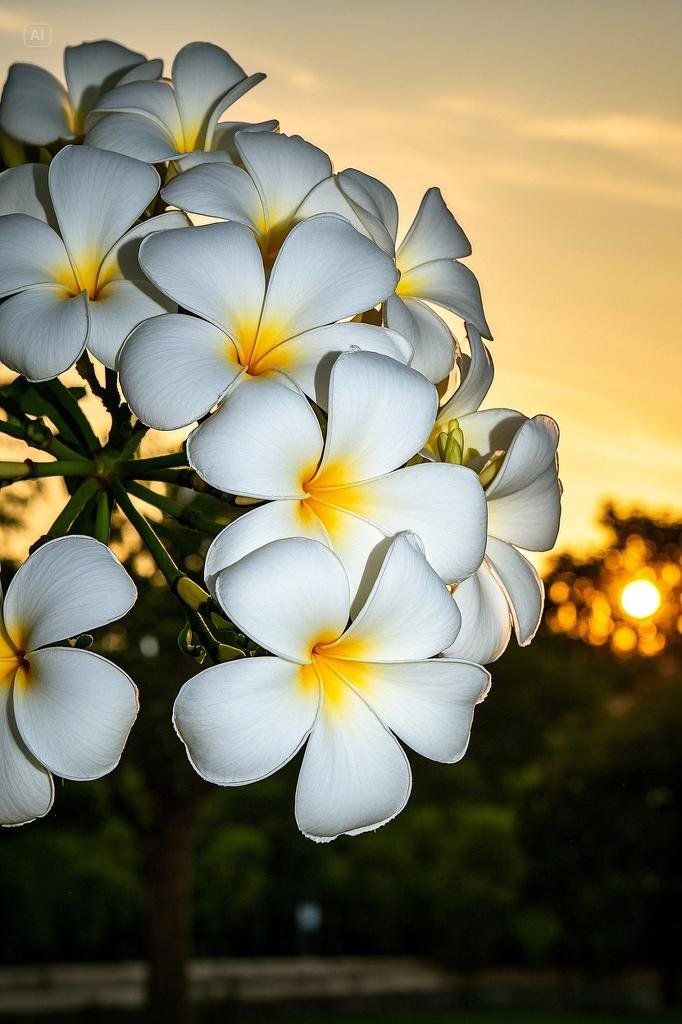
White petals, yellow in the center, perfectly simple, and yet they carry so much. It’s the kind of flower people glance past sometimes, thinking something so understated can’t be remarkable, and maybe that’s why I love it; they don’t need to shout to exist.
They just do, quietly, insistently, like a thought that keeps returning even when you’re busy ignoring it.
Plumeria has this way of being both ephemeral and eternal. Its petals eventually fall, light and fragile, but its fragrance doesn’t leave immediately; it lingers in the air and memory alike.
There’s a softness to it, a way it can touch without touching, that makes me think about how some of the most profound things in life are also the simplest. You don’t have to hold them to be affected by them.
I think of people this way sometimes, the ones who pass through your life, subtle at first, barely noticeable, and yet when they leave, a part of you is still scented by their presence.
The plumeria, in its quiet way, reminds me that influence doesn’t have to be loud. Influence can be tender, understated, gentle, and still leave a mark that won’t fade easily.
I love how it grows, almost stubbornly, reaching out like it has somewhere to be but no one to impress. Plumerias aren’t flashy; they don’t compete for attention with the roses or orchids or whatever blooms the world decides are worthy of admiration.
And maybe that’s why it feels so relatable. I’ve spent so many years trying to be noticed, trying to be loud, bright, convincing, when what I’ve really needed to do is just exist, persist, and let my own quiet fragrance do its work.
Sometimes, the simplest things are the ones that matter most; they just wait for the right moment, the right person, to truly notice them.
And the symbolism, oh, the symbolism. New beginnings. Grace. Positivity. The unfolding of the soul.
Plumeria feels like a gentle nudge to remind me that life is full of beginnings I might not yet see, that even the quietest growth is still growth, and that beauty doesn’t need approval to be beautiful. It’s a kind of validation I’ve been learning to give myself.
It’s an encouragement to keep growing in ways that feel honest and real, even when no one else is watching. Maybe that’s why I connect with it so deeply. It’s patient, enduring, yet fleeting in its moments of bloom, much like the pieces of myself I’ve been learning to recognize and honor.
I sometimes imagine a plumeria tree in the corner of my living space, not because it demands attention, but because it quietly transforms the space around it. You don’t have to touch it to feel its presence, and that is exactly how I want my own life to feel.
I want the things I do, the people I love, the lessons I carry, to leave a trace that is subtle but undeniable, scented but not suffocating, lasting but never cloying. I want to be plumeria-like in the best sense, quiet, persistent, fragrant in memory, simple but deeply resonant.
And yet, like most things worth noticing, plumerias are often overlooked. People see them, yes, but they barely stop to inhale, to consider, to appreciate the way they can linger in thought long after they’re gone.
That’s something I’ve realized about myself too. I am often overlooked in ways that sting, but maybe, like the plumeria, my value isn’t about being loudly seen. It’s about how I touch people, even if they don’t know it at the time.
It’s about the fragrance of my presence, the gentle persistence of showing up, of being unapologetically myself. It’s in the small, quiet things, the gestures, the words, the attention to detail, that people carry long after the rest has faded.
There’s also a vulnerability in the plumeria that I find beautiful. Fragile petals, fleeting bloom, a scent that can be missed if you don’t pause, breathe, and allow it to reach you.
I think about the parts of myself that feel delicate like this, the unspoken dreams, the soft corners of the heart, the things I protect so carefully, and how often I have to remind myself that just because something is quiet doesn’t mean it is weak.
The fragrance lingers. The impact remains. The beauty is undeniable if you take the time to notice.
Maybe that’s why I keep coming back to plumeria in my thoughts. It’s a mirror for the way I’ve been learning to live: with grace, persistence, softness, and subtlety.
To recognize that my value isn’t in the noise I make or the recognition I chase, but in the authenticity I carry. In the small, overlooked gestures of care and attention. In the ability to leave a mark without demanding acknowledgment.
Plumerias remind me that life’s quiet victories are still victories, and the simplest beauty can be the most revolutionary.
And there’s something almost sacred about the smell, isn’t there? The way it lingers long after the bloom has fallen, the way it becomes part of memory, almost indistinguishable from the moments it has colored.
That lingering scent is like love: it doesn’t vanish when the moment is gone. It persists, it hums quietly in your chest, it becomes a part of you, and sometimes, all you need is a brief inhale to remember everything.
That’s how I want my own presence to be; felt, remembered, treasured, even when I’m no longer in the room.
There’s something almost ironic about plumeria; the flower is soft, sweet, and inviting, its fragrance like a gentle caress that lingers long after you’ve passed it. And yet, the tree itself is said to be poisonous, a quiet reminder that even beauty can carry danger, that softness does not mean harmlessness.
It makes me think about life, about people, about moments I’ve loved deeply: just because something draws you in doesn’t mean it won’t sting if mishandled, just because something seems delicate doesn’t mean it lacks power.
There’s wisdom in that duality, in learning to appreciate beauty while respecting its boundaries, to inhale the sweetness of life without losing sight of its edges. It’s a lesson I feel I carry with me, one that makes me more careful, more aware, and somehow more alive.
It’s funny, the things you learn from a flower. I never expected a plumeria to teach me patience, subtlety, or self-appreciation, yet here I am, thinking about how much I resemble it more than I ever thought I would.
Waiting quietly. Blooming in my own time. Fragrant without seeking permission. Simple but unforgettable. And I can’t help but wonder how many other overlooked things, quiet moments, or small beauties in life are teaching the same lessons if we only pause long enough to notice them.
There’s a humility to plumeria, a generosity. It gives itself fully in bloom, without demand or expectation. It doesn’t ask for admiration; it simply exists.
That’s the paradox I’ve learned to embrace about my own life, the moments when I am most present, most myself, most fully alive, are also the moments when I need the least acknowledgment. The fragrance is enough. The impact is enough. The presence is enough.
I guess what I’m saying is, I see myself in plumeria, and it makes me feel seen in ways that no one else can always manage. There’s a quiet affirmation in noticing it, a gentle reassurance that beauty, grace, and resilience can coexist without the need for noise, without drama, without constant validation.
Sometimes the most profound lessons are delivered not through people, or events, or grand gestures, but through the quiet wisdom of a flower that no one paused long enough to fully notice.
And maybe that’s exactly how life works, how love, growth, and presence work. You bloom quietly, leave a scent behind, and trust that the ones meant to notice will notice, and the rest… will pass without harm.